
Our Services
Popular and in-demand NDT Services
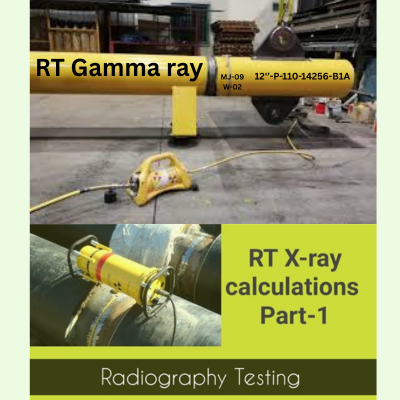
Radiography Testing (RT)
Radiography Testing provides a clear view inside critical components, ensuring structural integrity without causing any damage. By using advanced X-ray and Gamma-ray technology, this method detects hidden defects such as cracks, porosity, inclusions, and weld discontinuities that may not be visible on the surface.
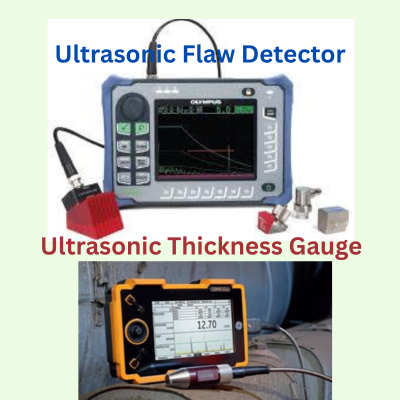
Ultrasonic Testing (UT)
Ultrasonic Testing (UT) is a highly precise non-destructive testing method used to detect internal flaws and measure material thickness without causing damage. By transmitting high-frequency sound waves into the material, UT identifies cracks, laminations, voids, and other hidden discontinuities that may compromise structural performance.
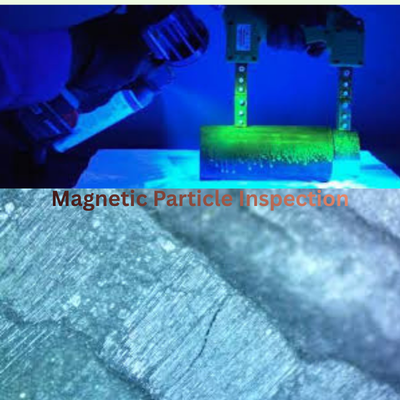
Magnetic Particle Testing (MT)
Magnetic Particle Testing is an effective Non-Destructive Testing method used to detect surface and near-surface discontinuities in ferromagnetic materials. This technique identifies cracks, seams, laps, and other defects that may affect the structural integrity of components such as welds, castings, and forged parts.
More NDT Services
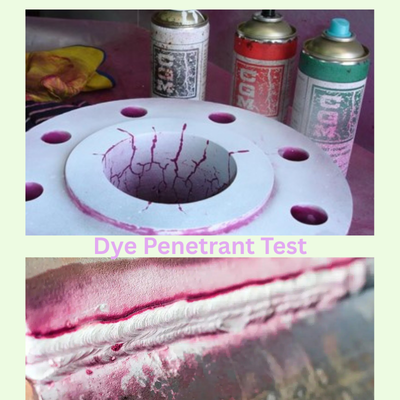
Dye Penetrant Testing (DPT)
Dye Penetrant Testing is a widely used for detecting surface-breaking defects in non-porous materials. This technique effectively reveals cracks, porosity, seams, laps, and other surface discontinuities that may compromise component performance. PT is suitable for materials such as metals, plastics, and ceramics.
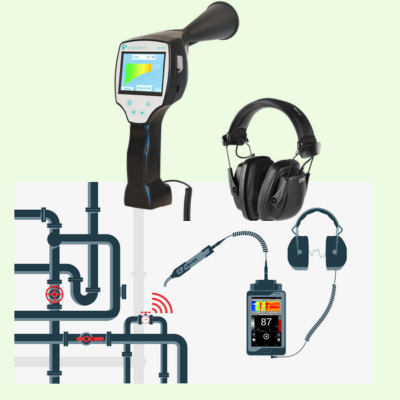
Ultrasonic Leak Detection
Ultrasonic Leak Detection Testing is an advanced inspection method used to identify leaks in pressurized and vacuum systems with high accuracy and efficiency. By detecting high-frequency sound waves generated by escaping gases or air, this technique pinpoints leaks in pipelines, valves, tanks, boilers, heat exchangers, and compressed air systems—even in noisy industrial environments.
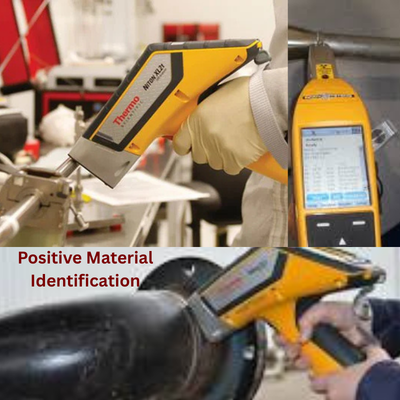
Positive Material Identification
Positive Material Identification is a critical Non-Destructive Testing method used to verify the chemical composition of metals and alloys. Using advanced technologies such as X-ray Fluorescence (XRF) or Optical Emission Spectroscopy (OES), PMI ensures that materials meet specified grade requirements and industry standards.
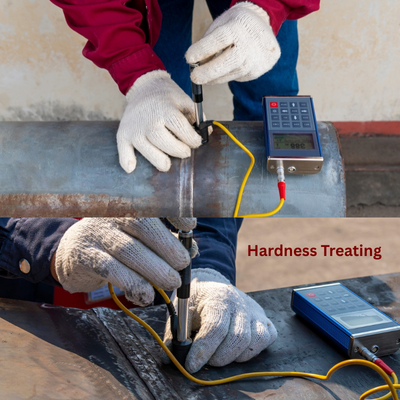
Hardness Testing
Hardness Testing is a vital inspection method used to determine a material’s resistance to indentation, wear, and deformation. It plays a crucial role in verifying heat treatment effectiveness, material strength, and overall mechanical properties of components such as welds, pipes, castings, and structural parts.
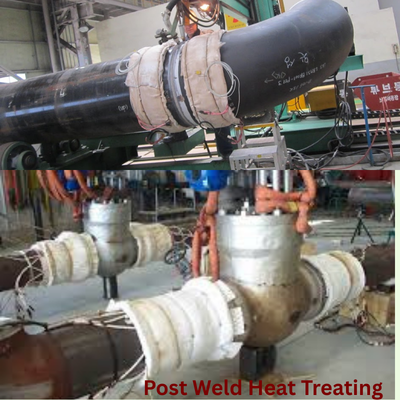
Post Weld Heat Treatment (PWHT)
Post Weld Heat Treatment is a controlled thermal process performed after welding to relieve residual stresses, improve toughness, and enhance the mechanical properties of welded components. PWHT reduces the risk of cracking, distortion, and brittle failure, ensuring long-term structural integrity and compliance with applicable codes and standards.
Zero Compromise on Safety. Zero Tolerance for Defects.
Where Engineering Excellence Meets Proven Integrity.
Certified NDT Services Designed to Protect Your Most Valuable Assets.
Request a Technical Consultation
Frequently Asked Questions
NDT is a testing method used to evaluate materials, components, or structures for defects without causing any damage. It ensures safety, quality, and reliability of industrial assets.
NDT helps detect hidden defects before failure occurs, reduces downtime, ensures compliance with standards, and protects people, equipment, and investments.
Common methods include Radiography Testing (RT), Ultrasonic Testing (UT), Magnetic Particle Testing (MT), Dye Penetrant Testing (PT), Visual Testing (VT), PMI, and Hardness Testing.
Industries such as oil & gas, power plants, petrochemicals, construction, manufacturing, and heavy fabrication rely on NDT for quality assurance.
Yes, in many projects NDT is required by codes such as ASME, API, and other regulatory standards.